
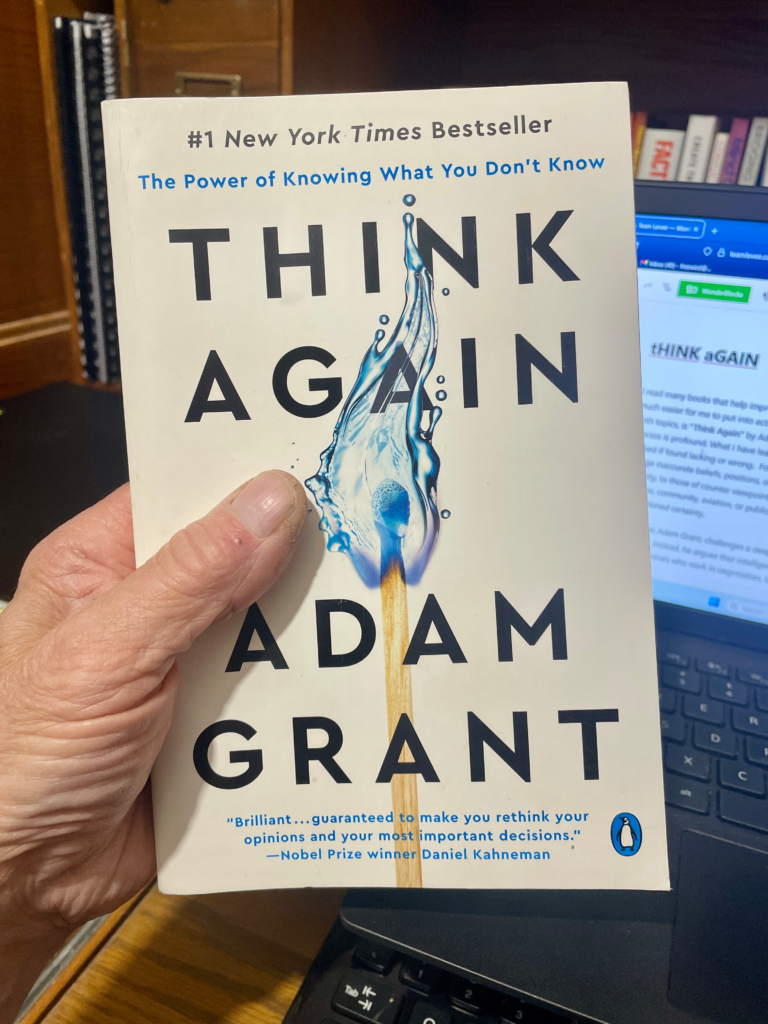
I like to read books about communication and problem solving. So far my favorite book, that spans both topics, is “Think Again” by Adam Grant. To me, the connectivity of this book to mediation is profound. I learned my facts must be questioned, tested, and revised if found to be lacking or wrong.
For most everyone it’s psychologically difficult to self question what you believe is fact. It’s also a challenge to actively listen, with honest curiosity, to those of counter viewpoints. Expounding further, we see in high-conflict environments—whether business, community, aviation, or public discourse—the greatest liability is often not ignorance. It is unquestioned certainty.
The author, Adam Grant, challenges a deeply ingrained assumption: that intelligence is demonstrated by conviction. Instead, he argues that intelligence is equally demonstrated by the willingness to reconsider. For professionals who work in negotiation, leadership, or mediation, this concept is not abstract. It is operational.
One of the most counterintuitive insights in Think Again is this: The smarter we are, the better we often become at defending flawed positions. High cognitive ability can amplify confirmation bias. We accumulate evidence selectively. We construct elegant justifications. We argue persuasively. But persuasion is not the same as accuracy.
Intellectual humility—the recognition that what we know might be incomplete—is not self-doubt. It is disciplined self-awareness. In complex disputes, the inability to rethink becomes a structural barrier to resolution.
Mr. Grant emphasizes environments where people feel safe to challenge ideas without personal consequence. Teams and organizations that normalize rethinking:
- Make fewer catastrophic errors.
- Adapt faster.
- Sustain stronger trust.
Psychological safety doesn’t mean agreement. It means disagreement without hostility. That distinction is crucial.
The Strategic Advantage of Rethinking
In fast-changing fields—technology, aviation, business, public policy—the cost of not rethinking can be significant. The strongest professionals are not those who never change their minds. They are those who change their minds for good reasons. Reconsideration is not instability. It is adaptive strength.
The discipline of rethinking requires restraint. It requires patience. It requires ego management. But it produces something rare:
Clarity without rigidity.
Conviction without arrogance.
Dialogue without escalation.
In an era defined by polarization, the ability to say “I might be wrong” is not weakness. It is leadership. And in environments where conflict is common, the courage to rethink may be the most stabilizing force available.
DISCLAIMER
The information provided on this blog is for general information purposes only and does not constitute legal advice, psychological counseling, or mediation services.